Part 1: The Charging Port Dilemma
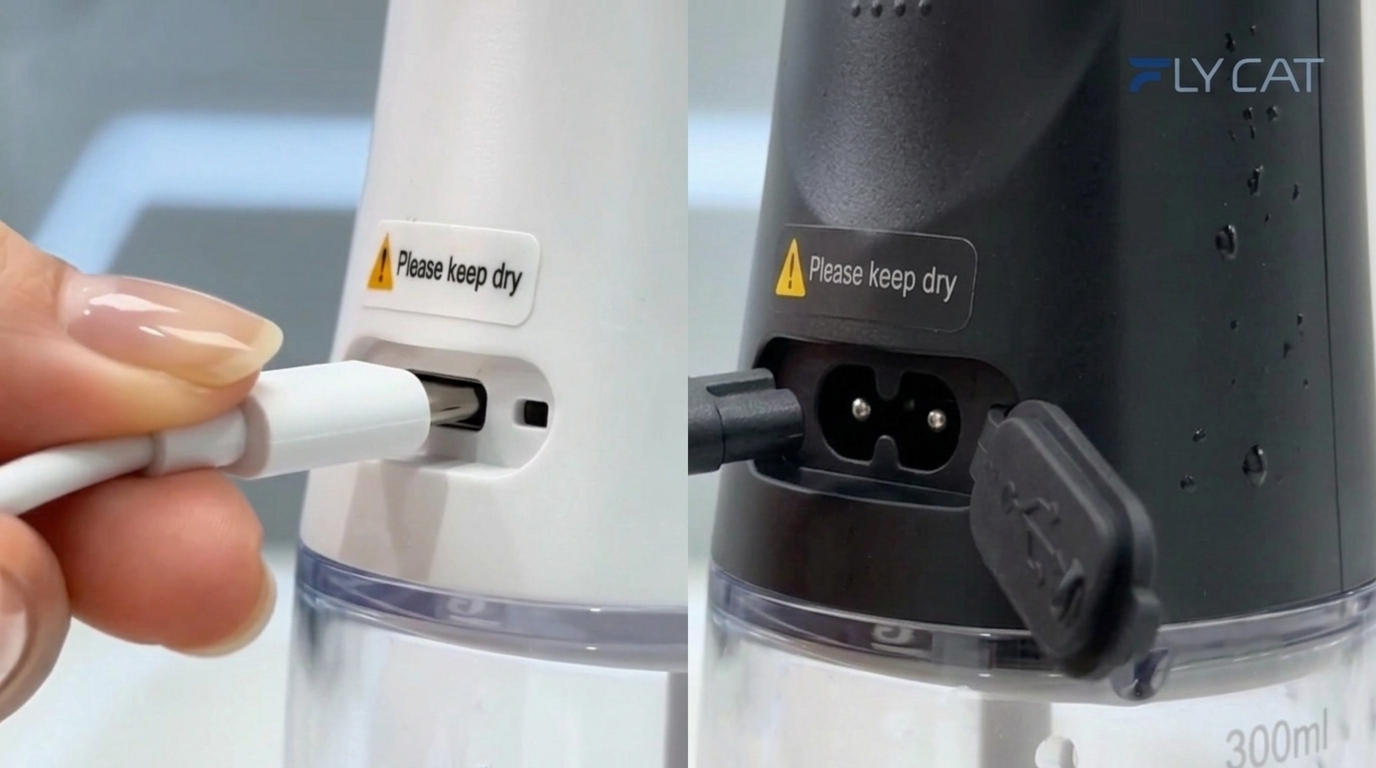
For any water flosser brand, one of the earliest decisions you will face is what charging port specification to adopt.
USB-C is the universal standard in consumer electronics — fast charging, plug-and-go, instantly familiar to users. So why isn’t every water flosser using USB-C?
The answer isn’t cost. It’s the use case: the bathroom.
Flycat’s lab conducted controlled aging tests on both charging port types under two conditions: saline solution and artificial sweat. These are precisely the moisture-laden environments your product faces daily in real users’ homes.
Part 2: The Testing Process
We tested both charging port types using two methods:
Method A: Plug and unplug the charging cable 30 times (simulating daily wear), then expose to saline solution and artificial sweat.
Method B: No pre-cycling of the receptacle; direct exposure to saline solution and artificial sweat.
The results could not be clearer.
USB-C Charging Port — Under Method A, after 30 plug/unplug cycles followed by exposure to saline solution and artificial sweat, both samples exhibited hotmelt, with oxidized pins on the internal PCB. Even under Method B (no pre-cycling), one sample showed hotmelt, with oxidation at the receptacle pin corners.
Figure-8 (C7) Charging Port — Under identical test conditions, the product charged normally. Neither the charging port nor the charging cable showed any heating or hotmelt. The figure-8 port passed all tests with zero failures.
Part 3: The Structural Logic Behind the Gap
The root cause lies in physical design.
The USB-C interface features densely packed exposed pins in a flat, wide form factor. Regardless of any IP rating label, this structure is inherently a weak point for moisture ingress in humid environments. The water flosser’s daily operating conditions — high-humidity bathrooms, frequent splashing, mirror condensation — consistently amplify this vulnerability.
The figure-8 (C7) port uses an embedded metal contact design with a deeper receptacle, offering naturally superior sealing compared to USB-C. It achieves reliable waterproofing without complex auxiliary protection, structurally eliminating short circuits and oxidation caused by water ingress.
Part 4: What This Means for Your Brand
Comparison Dimension | USB-C | Figure-8 (C7) |
Charging Speed | 4–6 hours | 6–8 hours |
Bathroom Safety | High risk (moisture ingress) | Low risk (test-verified) |
Long-Term Reliability | Pin oxidation, hotmelt risk | Stable after repeated moisture exposure |
User Experience Risk | Prone to failure in humid conditions | Consistent performance |
Universal Convenience | High (one cable for all devices) | Moderate (dedicated charger) |
At its core, the choice is a trade-off: USB-C gives you faster charging and the convenience of a single cable for all your devices. The figure-8 port gives you safety and reliability in the one environment where your product spends most of its life — the bathroom.
Part 5: Our Recommendation
If your product is designed as a fixed bathroom daily-use device — which applies to virtually all water flossers — we recommend prioritizing the figure-8 (C7) charging port. A 2-hour longer charge time is an acceptable inconvenience. A device failure due to moisture ingress is a brand reputation crisis.
Of course, both charging port types have their applicable scenarios, and the final choice depends on your brand positioning and target market requirements. Flycat offers full OEM/ODM support for both solutions.
Closing
Flycat has deep expertise in water flosser manufacturing spanning many years. Every design recommendation we make is grounded in laboratory testing, not paper assumptions. User safety is our core baseline — because your brand reputation is our brand reputation.
Contact our engineering team to discuss your product’s charging port solution →
WhatsApp: +8618194049265
Email: info@fly-cat.com.cn